
What Makes Security Control Room Design Work Seamlessly
Key Takeways
- Integrated systems lead to faster responses: When surveillance, alarms, lighting, and other operational tools are connected through a central interface, teams can act more quickly and with fewer errors.
- Bridging old and new technologies is essential: Aligning existing infrastructure with newer tools prevents disruptions, avoids unnecessary replacements, and ensures reliable performance across all systems.
- Automation enhances situational awareness: Trigger-based actions such as lighting changes or visual alerts help operators stay informed and focused during high-pressure scenarios.
Introduction
Effective security control room design goes beyond installing screens and equipment. In high-stakes environments such as transport networks, operations centres, and surveillance facilities, the configuration must support real-time coordination across systems, people, and space. Achieving operational clarity requires aligned workflows, intuitive interfaces, and seamless integration.
In this article, we explore the core design principles that enable control rooms to function as unified, responsive environments under operational pressure.
Why Unified System Control Improves Clarity
Modern control rooms often manage a vast ecosystem: surveillance cameras, access points, lighting, emergency alarms, and even HVAC systems. Without unified control, managing each component separately can lead to delays and confusion.
A well-integrated security control room design allows these systems to operate through a centralised interface. When surveillance, environmental controls, and emergency protocols operate in sync, operators can respond to developing situations more efficiently and with fewer errors.
How to Maintain Compatibility Across Legacy and Modern Systems
Many organisations continue to rely on legacy systems that perform essential functions. While these may not be easily replaced, integrating them with modern technologies presents operational and technical challenges that can affect overall performance.
Smart security control room design addresses this by enabling interoperability from the outset. Legacy infrastructure is connected with newer platforms, such as a control room video wall, allowing data to move seamlessly between systems. This reduces fragmentation, supports consistent operations, and protects long-term system stability.
Can Automation Make a Real Difference?
Automation plays a central role in improving response times and reducing operator workload. When specific events trigger predefined actions, critical systems can respond immediately without manual intervention.
For example, an unauthorised access alert might activate nearby lighting and display relevant camera feeds using the LED video wall controller. This streamlines awareness and supports faster decisions. Automation also ensures consistency by removing unnecessary steps during high-pressure situations.
Why User Interfaces Should Be Simple and Centralised
Overly complex interfaces can hinder performance, particularly in time-sensitive situations. Critical information can be missed or delayed when operators must navigate unclear layouts or switch between multiple systems.
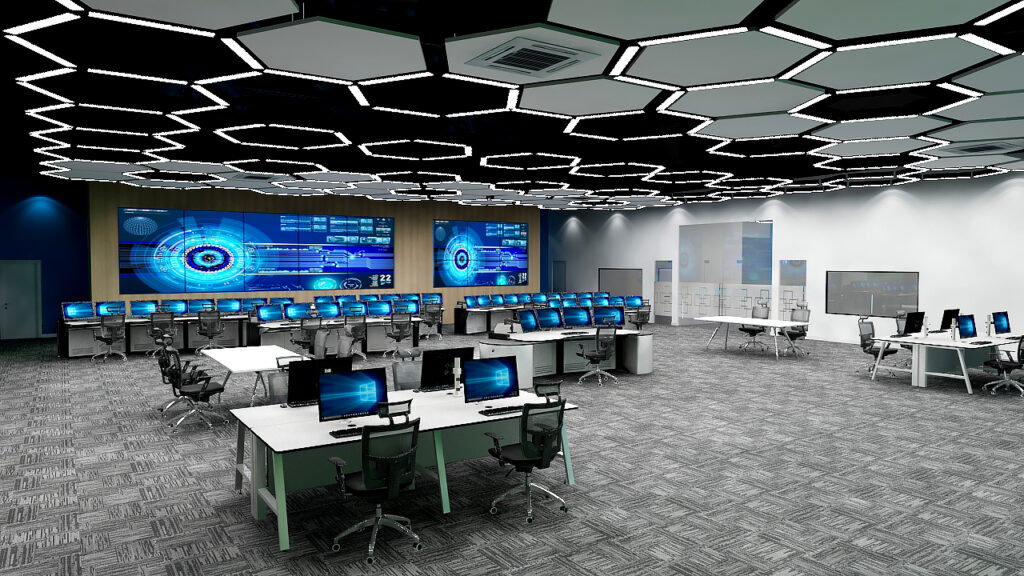
An intuitive interface that brings key functions into a unified platform helps reduce distractions and supports clear, timely action. Paired with a video wall, it ensures that both individuals and teams maintain consistent awareness. In a modern security control room, ease of navigation is essential to sustaining operational efficiency.
Why Integration Needs to Be Part of the Initial Design
Leaving system integration until the end of a project often results in added complexity, higher costs, and operational delays. Retrofitting platforms after installation can introduce compatibility issues that are difficult and time-consuming to resolve.
Thoughtful security control room design includes interoperability from the outset. By aligning systems early in the planning process, organisations reduce future friction, minimise downtime, and create a setup that can scale with evolving operational needs.
Designing Security Control Rooms That Perform Under Pressure
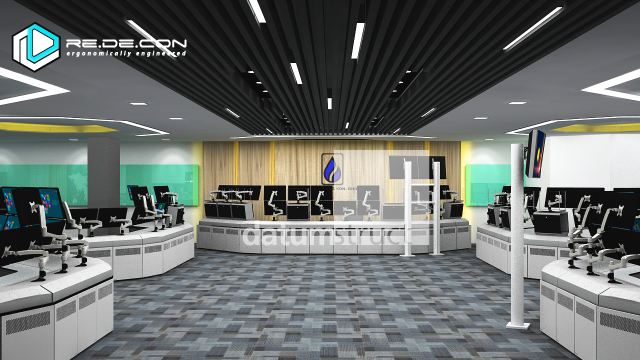
A high-functioning control room depends on seamless integration, intuitive interfaces, and systems that support fast, coordinated action. When designed with operator needs and interoperability in mind, it becomes an environment where critical decisions can be made quickly and with full situational awareness.
Datumstruct CFS delivers comprehensive security control room designs that connect technical planning with real operational demands. From spatial layout to integrated systems, each project is developed for long-term performance, adaptability, and ease of use.
Contact us today to build a control room that supports clarity, coordination, and confident decision-making from day one.
PRODUCT
FEATURED CASES
WHAT’S NEW
- Redecon Consoles vs Office Furniture
- What Is the Difference Between an Air Purifier and Air Sanitizer?
- The New Norm In The Control Room During Covid-19 Pandemic
- MIRI Global Certified That Air Halo Portable Air Sanitizer Can Eliminate 99% of Covid-19 Virus
- We're Upgrading!
- REDECON Consoles Featured in Pengerang Integrated Complex (PIC)

©2021 Datumstruct CFS | All Rights Reserved